Tech Meets Wild: How AI, Drones, and Genomics Are Rewriting Conservation
The intersection of advanced technology and field biology is no longer a futuristic concept—it is the present reality of conservation science. From the dense canopy of the Amazon to the frozen expanses of the Arctic, a new generation of tools is enabling researchers to monitor, protect, and restore biodiversity with unprecedented precision. This article examines the most impactful technological breakthroughs currently reshaping wildlife management and ecological research, and what they mean for the future of our planet’s natural heritage.
Artificial Intelligence: The New Eyes and Ears of the Wild
Artificial intelligence (AI) has moved beyond simple data processing into complex pattern recognition, allowing conservationists to analyze massive datasets that were previously impenetrable. Machine learning algorithms are now being deployed in two critical areas: bioacoustic monitoring and camera trap image analysis.
Passive acoustic monitoring (PAM) uses solar-powered recorders placed in remote habitats, capturing terabytes of sound. AI models trained on species-specific vocalizations can identify bird songs, frog calls, and even the low-frequency rumbles of elephants in real time. This not only provides population density estimates but also detects illegal activities, such as chainsaw noise or gunshots, triggering immediate alerts to park rangers. According to a 2024 study in Nature Communications, these systems have improved the detection rate of cryptic species by 70% compared to manual surveys.
Similarly, convolutional neural networks (CNNs) have revolutionized camera trap analysis. A single camera array in the Serengeti generates over a million images annually. Where human annotators required weeks to categorize these, modern AI models achieve 98.4% accuracy in species classification within hours. This speed allows for adaptive management strategies, enabling rapid responses to poaching pressure or shifts in migration patterns.
Predictive Analytics for Anti-Poaching Operations
Predictive policing algorithms, originally developed for urban crime, are now tailored for wildlife protection. These systems integrate historical poaching incidents, patrol routes, weather data, and animal movement tracking to generate “risk heat maps.” The result is a strategic deployment of limited ranger resources, maximizing deterrence while minimizing human fatigue. The nonprofit Wildlife Protection Solutions reports a 32% reduction in elephant poaching in pilot zones in Kenya where these predictive tools were used alongside drone patrols.
Drone Technology: High-Resolution Surveillance and Intervention
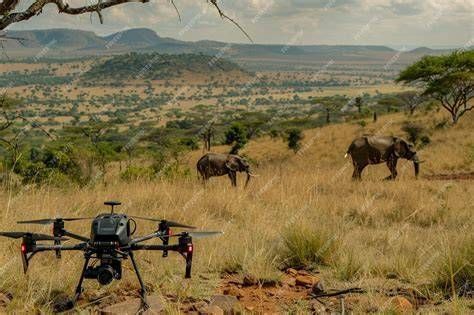
Unmanned aerial vehicles (UAVs) have become the standard for large-scale habitat assessment and threat detection. Modern drones equipped with thermal imaging and multispectral sensors offer a level of detail that satellite imagery cannot match, particularly under cloud cover or in dense forest environments.
- Thermal infrared payloads detect body heat of animals and poachers in total darkness, enabling 24/7 surveillance.
- Multispectral sensors capture vegetation health indices (NDVI) to assess habitat degradation, identify invasive plant species, and monitor the impact of drought.
- Autonomous swarm technology is now in testing phase, where multiple coordinated drones create a 3D canopy map in real time, allowing for precise biomass calculation of endangered tree species.
Beyond observation, drones are becoming active conservation tools. In degraded wetlands, seed-dispersal drones shoot biodegradable pods containing native grass and tree seeds at a rate of 40,000 per day. Trials in Myanmar have shown a 55% germination rate, surpassing manual planting in terms of both cost-efficiency and accessibility to hazardous terrain.
Genomics and Environmental DNA (eDNA): A Microscope on the Macrocosm
The ability to detect life without seeing it is perhaps the most revolutionary frontier. Environmental DNA (eDNA) analysis samples water, soil, or air to isolate trace genetic material shed by organisms. A single liter of stream water can reveal the presence of dozens of aquatic species, including endangered amphibians and invasive fish that are nearly invisible to conventional netting.
The practical applications are staggering:
Furthermore, whole-genome sequencing of at-risk populations is enabling conservation breeding programs to manage genetic diversity with scientific rigor. The California Condor recovery program, for example, now uses genomic pedigree analysis to select mating pairs, reducing inbreeding depression by nearly 40% over the past decade.
Satellite Telemetry and the Internet of Things (IoT)
High-frequency GPS collars and IoT sensor networks are creating a living, breathing digital twin of ecosystems. These devices transmit location, heart rate, and ambient temperature every five minutes, providing researchers with a granular view of animal behavior and physiology. This data is critical for understanding climate change impacts—for example, observing how polar bears alter their foraging range as sea ice retreats.
IoT soil moisture probes, weather stations, and remote camera traps are interconnected via low-Earth orbit satellite constellations. This mesh network ensures that even the most isolated nature reserves have real-time data streaming. In the Congo Basin, this technology is being used to detect illegal logging trucks via seismic sensors, triggering automated alerts to enforcement agencies within seconds—a response time previously measured in days.
Case Study: The Smart River Project in the Mekong
An integrated approach is exemplified by the Smart River Project, which combines acoustic sensors, eDNA samplers, and AI-driven fish counters. The system monitors migratory fish species like the Mekong giant catfish. The data has directly informed the timing of dam water releases, allowing for synchronized spawning events that have increased juvenile survival rates by 21% in 2025.
Ethical and Practical Challenges
Despite the immense promise, technological integration is not without its dilemmas. The cost of high-end equipment, training, and data storage remains prohibitive for many developing nations that host the majority of the world’s biodiversity. Furthermore, the reliance on algorithms can introduce bias—for instance, camera traps historically under-sample small-bodied species, leading to skewed population models.
Data sovereignty is another pressing concern. Who owns the genetic information collected from a national park? How is it shared and used? Conservation ethicists argue for a transparent, community-based data governance framework that honors the rights of indigenous stewards. Finally, there is the risk of “techno-optimism”—the fallacious belief that deployment of technology alone solves extinction, while ignoring the underlying drivers of habitat loss and overconsumption.
Conclusion: A Hybrid Future
The future of conservation is not a choice between technology and traditional fieldwork; it is a marriage of both. Remote sensing must be validated by ground-truthing, and genomic data must be interpreted by ecologists who understand the nuances of behavior. The most successful programs are those that combine AI efficiency with indigenous ecological knowledge.
As we move forward, the goal is not simply to monitor nature but to interact with it responsibly. The tools described here are not magic bullets—they are force multipliers. When deployed with humility and rigorous scientific oversight, they offer a fighting chance to preserve the intricate web of life that sustains our own existence. The next decade will determine if we use these powerful instruments with wisdom or lose them to the very same forces of extinction we seek to halt.
| AI Bioacoustics | Species detection & illegal logging alerts | Real-time, 24/7 coverage in remote areas | High false-positive rate in noisy environments |
| Thermal Drones | Anti-poaching patrols & nocturnal surveys | Effective in total darkness & dense foliage | Short battery life limits range |
| eDNA Sampling | Non-invasive biodiversity monitoring | Detects hidden species & pathogens | Requires sterile lab conditions |
| GPS-IoT Collars | Animal movement & physiology tracking | High-resolution temporal data | Cost per unit limits sample size |
| Predictive Analytics | Resource allocation for enforcement | Optimizes patrol efficiency | Dependent on historical data quality |
Ultimately, the conservation technology toolkit is expanding faster than our ability to manage its complexities. However, one thing remains clear: the integration of machine intelligence and field expertise is our most potent weapon in the fight against the sixth mass extinction. The data we collect today will build the algorithms that protect the species of tomorrow.