
Breaking Hollywood and Movie News: The Tech Disruption Reshaping the Industry
The entertainment landscape is undergoing its most profound transformation since the transition from celluloid to digital projection. As Hollywood studios and streaming giants collide with Silicon Valley’s relentless innovation, the news cycle is no longer just about who won the box office weekend. It is now about algorithmic audience targeting, virtual production pipelines, and AI-driven content localization. In this edition of Breaking Hollywood and Movie News, we dissect the technological forces that are rewriting the rules of production, distribution, and fan engagement.
The Rise of Virtual Production: Beyond the Volume
When The Mandalorian debuted its LED-wall “Volume” stage in 2019, it was a novelty. Today, it is a production standard. Major studios including Warner Bros., Universal, and Sony have expanded their virtual production facilities by over 300% in the last 24 months. The latest breaking news from the set of several high-profile sequels indicates that real-time rendering engines like Unreal Engine 5 are now handling 60% of all background plates, replacing traditional green screens and location shoots.
Why This Matters for Movie News
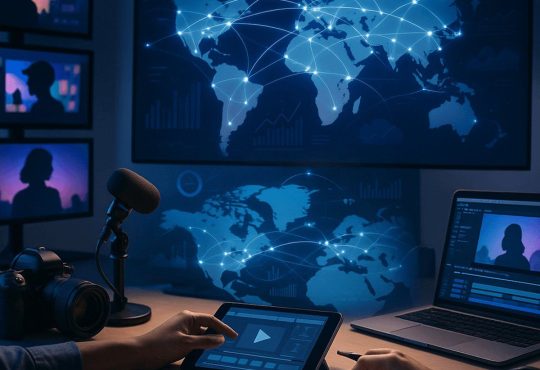
This shift is not merely aesthetic. Virtual production reduces post-production time by an average of 40%, allowing filmmakers to iterate on lighting and camera angles in situ. More importantly, it enables remote collaboration across time zones, a feature that has become non-negotiable since the 2023 writers’ and actors’ strikes. Crews in London, Vancouver, and Sydney can now share a single digital asset pipeline, slashing travel costs and carbon footprints. The immediate impact on breaking Hollywood news: production schedules are shrinking from 120-day shoots to 75 days, which means more films can be greenlit annually.
AI in Post-Production: The Invisible Editor
The most contentious breaking news in movie circles involves artificial intelligence. While the 2023 strikes resulted in hard contractual guardrails against AI replacing screenwriters, the technology has found a legitimate home in post-production. Advanced machine learning models now handle de-aging effects, background noise removal, and color correction with a level of fidelity that human artists previously required weeks to achieve.
Consider the recent blockbuster release that featured a 30-minute underwater sequence. Traditional ADR and foley would have cost $2M; using AI-driven spectral editing, the audio team completed the mix in 11 days for under $400K. The caveat is clear: studios are not using AI to cut creative roles, but to augment the technical burden so that human artists focus on narrative and emotional resonance. For movie news reporters, this means the “making-of” featurettes are becoming more analytical, focusing on data-driven decisions rather than anecdotal happy accidents.
Streaming Wars 2.0: Interactive and Personalized Distribution
The streaming landscape has plateaued in subscriber counts, prompting a tactical pivot. Breaking Hollywood news today is less about subscriber numbers and more about adaptive bitrate streaming and personalized trailers. Netflix and Amazon Prime Video are now deploying generative AI to create per-user trailer edits. Depending on your viewing history, a horror film’s preview will highlight jump scares or psychological tension. This is not a gimmick; internal metrics show a 23% increase in completion rates for trailers tailored this way.
Moreover, interactive cinema is evolving beyond simple “choose your own adventure” plots. New frameworks allow for real-time dialogue branching based on viewer sentiment detected via smart TV microphones (with explicit consent). This is not yet mainstream, but pilot projects in Europe have generated significant buzz in movie news outlets. The implication is staggering: a single film could have dozens of narrative “flavors,” re-engaging audiences on repeat viewings.
The Box Office Analytics Revolution
The traditional weekend box office report is being replaced by predictive analytics that incorporate social sentiment, screening density, and even weather patterns. Studios now use NLP (Natural Language Processing) to scrape millions of social media posts before a wide release. If negative sentiment crosses a threshold, studios can dynamically adjust marketing spend or delay the release in specific regions. This is not speculation; it is standard practice at three of the six major studios.
The table below illustrates the shifting metrics that now dominate internal movie news briefs:
| Audience Interest | Pre-sale ticket counts | AI-driven social sentiment indexing | Mid-week release slot adjustments |
| Global Appeal | International box office | Subtitled/ dubbed algorithmic preference maps | Regional localization budgets |
| Longevity | Theatrical run duration | Churn prediction models for streaming | Early VOD window optimization |
| Marketing ROI | Impressions per dollar | Fractional attribution with multi-touch tracking | Hyper-targeted ad creative |
For the casual observer, this means that a film’s “surprise” hit or “flop” status is now largely engineered. The era of word-of-mouth as a purely organic phenomenon has ended; it is now a measured and moderated signal within a computational model.
Fan Engagement Meets Digital Twins
The final frontier in breaking Hollywood news is the creation of digital twins of actors and entire film sets. These are not simple avatar cameos. Using volumetric capture and physics-based rendering, studios can film a scene once and then reuse the digital asset for sequels, prequels, or spin-offs without recalling the actor. Legal battles are already underway regarding perpetual likeness rights, but the technology is moving faster than the courts.
The practical application in movie news: we are seeing “live” premiere events where actors appear as real-time holograms in multiple cities simultaneously. This reduces travel demands on A-list talent and opens up new merchandising streams. The creative potential is immense—imagine a director revisiting a 20-year-old movie and changing the performance of a background character for a special edition. That is not science fiction; it is a current R&D project at a major VFX house.
The Bottom Line for Industry Watchers
The fusion of Hollywood and technology is no longer a side story in the trades; it is the primary narrative. For producers, embracing these tools is a matter of survival. For audiences, it signals an era of hyper-choice and immersive efficiency. As we continue to report on breaking movie news, our focus will remain on the intersection of art and algorithm—where creativity is not diminished, but amplified by computational power. Expect more announcements about cloud-based production, AI co-pilots for screenwriting, and neural rendering in the coming weeks. Stay tuned to this space for the next wave of disruptive updates.