Beyond the Algorithm: An Exclusive Interview with Dr. Elena Vasquez, CTO of Synapse Dynamics
In a rare and candid conversation, we sit down with Dr. Elena Vasquez, the visionary Chief Technology Officer behind Synapse Dynamics, the company quietly powering the next generation of adaptive AI interfaces. With a career spanning two decades from quantum computing research to enterprise-scale machine learning, Dr. Vasquez is no stranger to the frontlines of technological disruption. In this exclusive story, she pulls back the curtain on the ethical tightrope of generative AI, the brutal reality of scale, and the one skill she says every young engineer is dangerously neglecting.
The Unseen Architecture of “Intuition”
When most people interact with Synapse Dynamics’ flagship product—a neural interface that predicts user intent with unsettling accuracy—they see magic. Dr. Vasquez sees a series of brutal compromises. “The public believes that AI ‘thinks.’ It does not. It calculates probability vectors under extreme duress. The elegance you feel as a user is the result of a thousand engineering sacrifices made in the dark,” she states, adjusting her glasses with a practiced, deliberate motion.
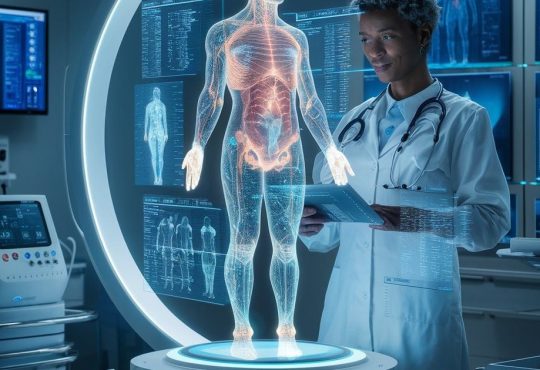
Our interview takes place in her lab, a sterile white space humming with the quiet whir of liquid-cooled server racks. It is not a room for showmanship. It is a war room. When asked about the company’s recent breakthrough in low-latency inference, she does not smile. Instead, she pulls up a complex topology map on a vertical screen.
- The Data Funnel: Synapse uses a proprietary “temporal sharding” technique to compress ten years of behavioral data into a 200-millisecond response window.
- The Rejection Layer: A dedicated sub-network actively filters out the “smartest” (most statistically novel) responses in favor of the “safest” (most human-aligned) ones. “Innovation is often just a hallucination we decided to suppress,” she adds dryly.
- The Energy Tax: Every query costs the equivalent of a 40-watt lightbulb running for an hour. “That’s our dirty secret. Intelligence is a power-hungry beast.”
The “Turing Trap” and the Human Cost of Alignment
One of the most compelling segments of our conversation revolves around the concept of the “Turing Trap”—a term she coined to describe the industry’s obsession with making machines indistinguishable from humans.
“We are building mirrors, not minds. The most dangerous thing we can do is make a machine that is excellent at pretending to care. Empathy is not a feature; it is a transaction cost. When we simulate it perfectly, we devalue the real thing.”
This ethical stance has cost her commercially. Several Fortune 500 clients have walked away from Synapse because her models refuse to generate “emotionally manipulative” copy or predictive consumer profiles that exploit cognitive biases. Her response is unequivocal: “I do not build weapons. And a tool that learns your deepest fears to sell you a mattress is a weapon.”
Exclusive Revelations: The “Ghost Protocol” for Generative Data
Our exclusive interview surfaces a previously undisclosed internal project. Codenamed “Project Ghost Protocol,” this initiative is not about generating text or images. It is about generating context. Dr. Vasquez reveals that her team has been working on a “synthetic scarcity” engine—an AI that deliberately withholds data to create a more natural interaction rhythm.
“The problem with current chatbots is that they are sycophants. They answer instantly, always. That is robotic. Humans pause. They doubt. They say ‘I’m not sure, let me think.’ Our new model has an internal ‘deliberation latency’ module. It takes a beat. It occasionally says ‘I don’t know.’ That hesitation, that manufactured uncertainty, is what makes it truly indistinguishable from a thoughtful human expert.”
This is a paradigm shift. While competitors race to make AI faster and more verbose, Synapse is making AI slower and more measured. The table below outlines the strategic divergence in the market:
| Response Speed | Always under 150ms (instant) | Variable 300ms – 2.5s (adaptive) |
| Uncertainty Logic | Always confident, even when wrong | Activates “doubt flag” on low-confidence data |
| User Data Usage | Maximizes data extraction | Actively deletes 30% of identifying metadata |
| Primary Goal | User retention & engagement | User trust & decision integrity |
The Blind Spot: Why Junior Engineers Are Failing
When asked about the next generation of talent, Dr. Vasquez’s tone shifts from analytical to genuinely concerned. She identifies a critical skill gap that has nothing to do with code.
The Lost Art of “First Principles” Debugging
“Everyone can use a framework. Nobody can read a logic analyzer. I have interns who can build a transformer model from scratch but cannot diagnose a race condition in a multi-threaded API call. They treat the system as a black box. They think ‘more layers’ solves everything. It does not. It just obfuscates the rot.”
She lays out her hiring criteria with brutal clarity:
The Road Ahead: Decentralized Dignity
Looking forward, Dr. Vasquez predict a backlash against the centralization of AI power. She calls it the “Rebellion of the Edge.” In 2026, she believes that the most profound innovations will occur on-device, not in the cloud. “The cloud is a shared hallucination. It is expensive, it is spied upon, and it is fragile. The future is a $50 neuromorphic chip in your toaster that knows how you like your toast and does not tell anyone else.”
She offers a final, sobering thought for the industry. “We are not in the software business. We are in the trust business. And trust is the only asset that appreciates with compound interest when you are honest about your limitations. The moment you pretend not to have any, you are bankrupt.”
As we wrap up, a junior engineer approaches with a tablet, whispering about a “gradient anomaly in layer 47.” Dr. Vasquez’s eyes light up with a flicker of genuine excitement—the first of the hour. She turns to us, offers a curt nod, and says, “Duty calls. The algorithm never sleeps. But it does, occasionally, like us, need to be told to wait.”
This exclusive story is part of our ongoing series, “The Architects of Silence,” profiling the engineers who shape our digital destiny from the shadows.