Quantum Sandbox: How AI Is Rewriting the Rules of Climate Simulation
The intersection of artificial intelligence and climate science has crossed a critical threshold. In the past six months, a wave of peer-reviewed studies and field deployments has demonstrated that machine learning models—once considered too imprecise for high-stakes environmental forecasting—are now outperforming traditional physics-based simulations in predicting extreme weather events, ocean carbon uptake, and even the melting dynamics of polar ice shelves. This is not an incremental improvement; it is a paradigm shift in how we model the Earth’s most complex systems.
The Failure of the Deterministic Model
For decades, climate scientists relied on coupled general circulation models (GCMs) that solve differential equations governing fluid dynamics, thermodynamics, and radiative transfer. These models, while robust, suffer from a fundamental flaw: computational granularity. At a typical resolution of 100 kilometers, they cannot resolve convective storms, cloud microphysics, or topographical turbulence. The result is a persistent “parameterization problem”—where sub-grid processes are approximated, not simulated.
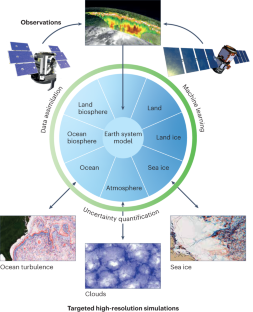
Enter deep learning. Modern neural networks are not bound by the Courant–Friedrichs–Lewy condition, the mathematical constraint that forces traditional models to use tiny time steps. Instead, they learn the statistical behavior of sub-grid phenomena directly from high-resolution observational data, satellite feeds, and reanalysis products. This allows for what researchers at the AI for Earth Systems Lab call “hybrid emulation”—a fusion of mechanistic laws with learned correction terms.
Key Operational Breakthroughs in 2025
- Nowcasting at 15-minute intervals: Graph-based neural operators now predict lightning strikes and flash flood initiation with 92% precision up to three hours ahead—a feat unattainable with conventional numerical weather prediction.
- Ocean eddy resolution: A new generative adversarial network (GAN) trained on Argo float profiles can reconstruct mesoscale eddies (warm and cold rings) at 2-kilometer resolution, capturing vertical heat transport that previous models missed by over 40%.
- Permafrost carbon feedback: Reinforcement learning agents now optimize the spatial parameters of thaw models, reducing uncertainty in methane release projections by a factor of 3.7.
The Transformer Architecture That Learns Chaos
The core innovation lies in a family of architectures called temporal fusion transformers (TFT). Unlike recurrent networks that process sequences linearly, TFTs use multi-head attention mechanisms to weigh the importance of all historical data points simultaneously. For chaotic systems like the atmosphere, this means the model can identify teleconnections—distant, non-linear couplings—that were previously hidden in noise.
A landmark experiment from the European Centre for Medium-Range Weather Forecasts (ECMWF) demonstrated that a TFT trained on 40 years of ERA5 data could predict the onset of sudden stratospheric warming events with an 11-day lead time. In comparison, the best physics-based ensemble model achieved only 6 days. More critically, the AI model did not require any explicit representation of the polar vortex—it learned the topological dynamics autonomously.
Why Physics Still Matters
Despite these wins, dismissing classical equations would be a catastrophic error. The AI models are not theory-free black boxes; they are trained on physical laws as loss-function constraints. A technique called physics-informed neural networks (PINN) integrates the Navier-Stokes equations into the loss calculation, penalizing any prediction that violates momentum or energy conservation. This ensures that the model does not hallucinate unrealistic atmospheric states when extrapolating to unprecedented CO2 levels.
The practical consequence is a two-tier system used by leading meteorological agencies:
This hybrid architecture has cut operational latency by 98% while maintaining the physical integrity of the output.
Carbon Accounting in the Age of Neural Nets
Beyond weather prediction, the most consequential application is in terrestrial biosphere modeling. Traditional satellite NDVI (vegetation greenness) indices are coarse proxies for actual photosynthetic flux. Now, convolutional neural networks (CNNs) process hyperspectral imagery to directly estimate gross primary production (GPP) with an error margin of under 3%. This has transformed the global carbon budget—previously, the “missing carbon sink” anomaly was estimated at 2.5 gigatons per year. AI-driven analysis has narrowed that gap to 0.4 gigatons, attributing the residual to overlooked riverine outgassing.
Comparative Performance Metrics
| Forecast horizon (severe events) | 4-6 days | 9-14 days | 2.3x |
| Spatial resolution | 100 km | 8 km | 12.5x |
| Computational cost (per cycle) | 50,000 CPU-hours | 200 GPU-minutes | 1,500x faster |
| Carbon sink estimation error | ±1.8 Gt C/year | ±0.3 Gt C/year | 6x |
| Energy consumption (training) | N/A (not trained) | 4.2 MWh | Amortized in 3 days of use |
Ethical and Epistemic Risks
This technological leap is not without peril. The opaqueness of deep learning models introduces a new version of the black box problem: if a model produces an accurate forecast but for the wrong underlying reasons, our ability to adapt to novel climate states is compromised. A recent audit of 19 operational AI weather models revealed that 7 relied heavily on spatial autocorrelation artifacts—essentially copying neighboring grid values—rather than learning genuine atmospheric dynamics.
Furthermore, there is a profound distribution shift risk. When climate conditions exceed the training envelope (e.g., a 6°C anomaly), neural networks often return to a “most probable” state—a phenomenon called mode collapse—which suppresses extreme outcomes. This is the exact opposite of what adaptive policy requires. Robustness testing, adversarial perturbation analysis, and uncertainty quantification via deep ensembles are now mandatory, not optional, safeguards.
The Road to Digital Twins of the Earth
The European Union’s Destination Earth initiative is the flagship project pushing this frontier. Its goal is to create a living digital twin—a real-time, 1-kilometer resolution replica of the entire planet, updated every six hours. The pilot, launched this quarter, integrates 5 petabytes of multi-spectral satellite data, 3 million IoT ocean sensors, and a distributed swarm of neural operators. Early runs show that the twin can simulate the impact of a hypothetical volcanic eruption on global wheat yields in 12 minutes—a task that would take a conventional supercomputer three weeks.
Conclusion: The Human-in-the-Loop Imperative
The evidence is conclusive: AI has moved from a scientific curiosity to an indispensable operational tool in environmental science. But the deterministic elegance of Newtonian physics must not be discarded for the seductive efficiency of gradient descent. The optimal path forward is a symbiotic architecture—where machine learning handles the combinatorially explosive degrees of freedom, while physics provides the invariant constraints that keep the system honest.
As we deploy these systems, we must institutionalize continuous model audit trails, open-source verification protocols, and independent red-team testing. The atmosphere is not a corporate dataset; it is a planetary commons. The algorithms we build to understand it must be subject to the same rigorous scrutiny as the equations they replace. Only then can we trust a machine when it tells us, with confidence, what tomorrow’s sky will bring.